RFP Response Software That Runs the Whole Bid
TenderOS reads your tender pack, extracts every requirement, separates the mandatory ones and drafts responses grounded in what your company can actually prove. From a 200-page RFP to a response-ready workspace in minutes.
What RFP response software actually has to do
Most tools sold as RFP software solve one slice of the problem. Some are content libraries. Some are writing assistants. Some are project trackers with an RFP label on them. The work your team is drowning in sits between those slices: reading a document pack nobody has time to read, turning it into a defensible list of obligations, deciding whether the bid is even winnable, finding the evidence, writing the answers, and proving to yourself the night before submission that nothing mandatory was missed.
Real RFP response software has to carry that whole chain. It has to ingest the documents in the state the buyer actually sent them — a main RFP, a terms document, three specification annexes, a pricing template and two addenda issued after the fact. It has to find the obligations wherever they hide, including the ones buried in general conditions that nobody reads until the disqualification letter arrives. It has to remember what your company has already proven, so the fortieth security questionnaire is not written from scratch like the first. And it has to be honest about what it does not know, because a proposal that claims a certification you do not hold is worse than no proposal at all.
That is the standard TenderOS is built to. It is an RFP management platform rather than a generator: the analysis comes first, the structure comes second, and the drafting happens only once the system knows what the buyer requires and what you can prove.
The short version. Other AI tools help you write an answer. TenderOS helps you run the entire bid — from the first read of the document to the final completeness check before you upload.
The RFP is not difficult because of one question
Any competent subject expert can answer a single question well. What breaks teams is the volume, the scattering and the deadline arriving all at once.
The obligations are scattered
A single tender can contain well over a hundred separate obligations spread across the scope of work, the terms, the specification annexes, the pricing template and the forms. The ones that disqualify you are rarely the ones printed in bold.
The evidence is somewhere else
The certificate exists. The case study exists. The insurance schedule exists. They live in four different folders, two of them owned by people who left, and one of them expired last quarter without anyone noticing.
The contributors are not synchronised
Security answers one section, finance another, legal a third, delivery a fourth. Nobody owns the whole picture, so the same number appears three different ways and nobody sees it until a reviewer catches it — or does not.
The dates move
A clarification deadline, a site visit, a bid validity period, a submission cut-off in a timezone that is not yours. Then an addendum shifts one of them and quietly changes four requirements you had already signed off.
The work starts too late
By the time the team knows what the tender actually demands, a third of the available days are gone. The decision to bid at all was made on a skim read of the executive summary rather than on the eligibility conditions.
The final check is a scramble
The last night before submission is spent cross-referencing a spreadsheet against a folder against a portal, hoping the count is right. That is not a review process. It is a memory test under time pressure.
From unstructured documents to a structured bid workspace
The same content, held in a form your team can assign, track, evidence and finish.
What the buyer sends
A main RFP, terms and conditions, specification annexes, a pricing template, mandatory forms and any addenda issued along the way.
What TenderOS builds
Each item stays linked to the page and clause it came from, so any figure in the workspace can be traced back to the sentence in the source document that produced it.
The modules that make up the RFP management platform
Eight parts, one workspace. Each one exists because a specific stage of the bid used to be done by hand in a spreadsheet or not done at all.
Tender Analyzer
Upload the tender pack and TenderOS reads it end to end: scope, issuer, submission method, deadlines, eligibility conditions and every clause that asks you to do something.
- Full requirement extraction
- Deadline and date detection
- Page-level source traceability
Compliance Matrix
Every extracted requirement becomes a row you can filter, assign and track — clause reference, page number, original wording, normalised wording, owner and status.
- Spreadsheet-grade filtering
- Mandatory and pass/fail flags
- DOCX, XLSX and PDF export
Company Brain
Your approved company knowledge in one place: profiles, certifications, insurances, case studies, CVs, policies and previously approved answers.
- Approved claims library
- Certificate expiry tracking
- Reused across every future bid
Evidence Matcher
For each requirement, TenderOS searches your Company Brain and tells you whether the proof exists, which document holds it, and where nothing was found.
- Strong / possible / weak matches
- Missing-evidence flags
- Expired-document warnings
Response Studio
Draft answers grounded in the requirement text and your approved evidence — never in invented company facts. Missing information is marked, not fabricated.
- Grounded, cited drafts
- Word and page limit enforcement
- Review and approval workflow
Bid Fit
Before your team writes forty pages, see the blockers: missing certifications, insufficient references, a deadline four days out, an eligibility rule you cannot meet.
- Strong / conditional / weak fit
- Reasoned blockers, not a score
- No invented win probability
Risks & Clarification Questions
Contract clauses worth a second look, ambiguous scope, contradictory dates and undefined volumes — each linked back to the clause that raised it.
- Draft risk register
- Commercial review flags
- Source-linked questions
Submission Readiness
A completeness check, not a prediction: how many mandatory items are done, which responses await approval, which document expired, what still blocks submission.
- Transparent completeness math
- Blocker resolution list
- Final review before export
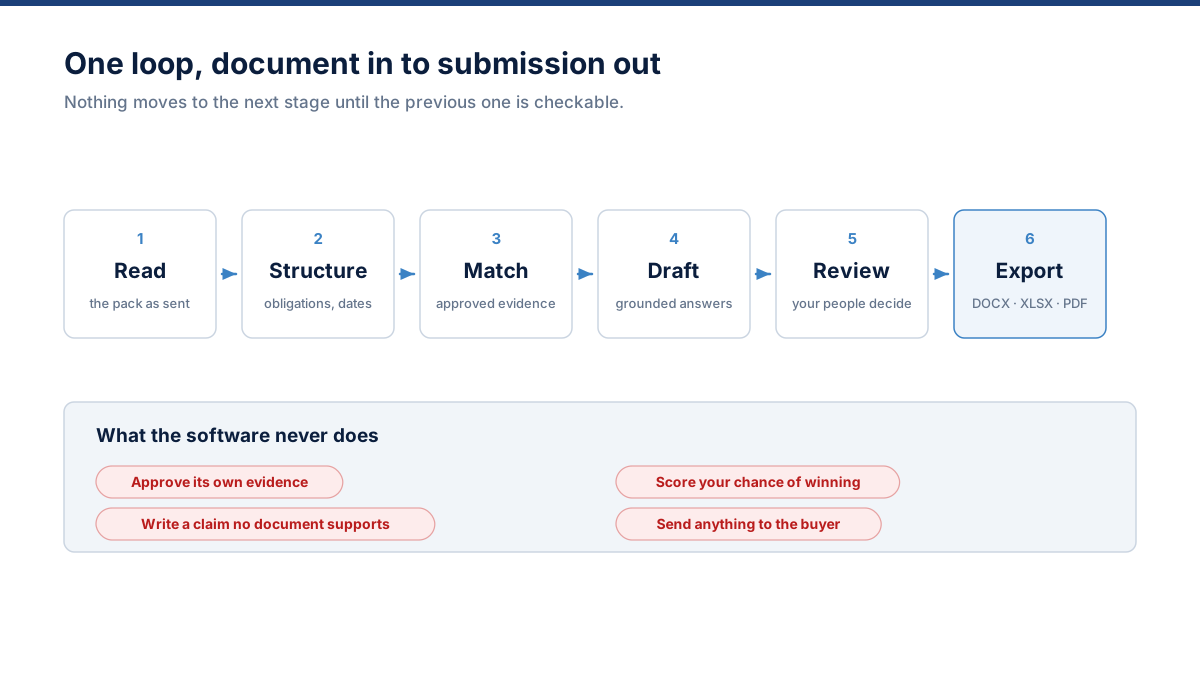
How the RFP automation software runs a bid end to end
Six stages. The software does the reading, structuring, matching and checking. Your organisation keeps every decision that carries commercial or legal weight.
Load the tender
Paste the RFP text or open the document pack. TenderOS reads the main RFP, terms, specifications, forms and annexes rather than treating them as one undifferentiated blob.
Extract the requirements
Every clause that asks you to do, provide, prove or accept something becomes a tracked requirement, tagged mandatory or not, and linked back to its page and clause reference.
Qualify the opportunity
Bid Fit compares the eligibility rules and requested evidence against what your organisation can actually prove, and names the blockers before anyone starts writing.
Match the evidence
Each requirement is checked against your Company Brain — certificates, case studies, CVs, policies, insurances and approved answers — so gaps surface while there is still time to close them.
Draft, review, approve
Responses are drafted from the requirement text and your approved evidence, with missing information marked rather than invented, then routed to the right reviewer for approval.
Validate and export
A completeness check counts what is done, what is blocked and what is still unapproved, then exports the proposal, the compliance matrix and the submission checklist.
Stop building your compliance matrix by hand
The matrix is where a bid is actually managed. Every extracted requirement becomes a row with its clause reference, its page, the buyer's original wording, a normalised restatement, its category, whether it is mandatory, whether it needs evidence, who owns it, what proof is attached and where the draft answer stands.
It behaves like a spreadsheet because that is what bid teams already know — search, sort, filter, group, bulk assign, bulk update — but every row keeps its link back to the source document, so a disputed requirement is settled by opening the page it came from rather than by arguing from memory.
The original clause is never overwritten. TenderOS stores the buyer's exact sentence alongside the plain-language version your team works from, because at evaluation time the wording that matters is theirs, not yours.
Your best answers already exist somewhere
Almost nothing a buyer asks is genuinely new. Your methodology has been described before. Your certifications have been listed before. Your reference projects have been written up before. The material exists — inside old proposals, company profiles, policy documents, certificates, team CVs and technical architecture papers that nobody can find under deadline.
Company Brain is where that becomes reusable. You upload the organisational knowledge once, TenderOS extracts structured entities from it — certificate names and expiry dates, case study clients and technologies, team qualifications — and a human on your side approves what is accurate. Approved knowledge is what the drafting layer is allowed to draw on.
It compounds. The second tender is faster than the first because the evidence is already indexed. The tenth is considerably faster because the wording, the proofs and the structure are all sitting there, current and approved.
What goes in
- Company profiles, service descriptions and product sheets
- Certifications, licences and insurance certificates with expiry dates
- Previous proposals and previously approved tender responses
- Case studies and project references with client, sector and technology
- Team CVs, qualifications and project experience
- Policies, methodology documents and technical architecture
- Quality procedures, SLAs and implementation plans
AI that knows when it does not know
The most dangerous thing an AI proposal tool can do is answer confidently on your behalf about something your company cannot prove.
Never invents company facts
No certification, client, project, revenue figure, headcount, office, insurance policy, service level, security control or qualification is ever asserted unless a document in your Company Brain or an explicit input from you supports it.
Asks instead of guessing
Where the evidence does not exist, the draft returns an explicit marker — input required, evidence missing, company confirmation required — and a specific question you can answer, rather than a plausible sentence you would have to catch in review.
Labels its own confidence honestly
Responses are marked grounded, partially grounded or needs input based on whether the material claims are actually supported. There is no invented accuracy percentage, because there is nothing real to measure it against.
Expired evidence is flagged rather than used silently. Contradictions between two of your own documents are surfaced rather than resolved behind your back. Every generated answer can be opened to see which tender clause and which company document produced it.
Know the blockers before you spend days writing
Bid Fit assesses the opportunity against reality: the eligibility conditions, the mandatory requirements, the evidence you hold, your experience match, the timeline, the geography, the required certifications and your available resources. It returns strong, conditional or weak fit — with the reasons.
- Required industry experience found in four comparable engagements
- A mandatory certification requested, with no valid evidence on file
- Five references requested; three currently indexed
- Submission deadline four working days away
What it will never show you is a win probability. There is no validated statistical basis for one, so the product does not pretend otherwise.
The bid/no-bid frameworkA final check made of arithmetic, not optimism
Submission Readiness measures completeness and nothing else. How many mandatory items are finished. How many blockers remain open. How many responses are still waiting for approval. Whether any attached document has expired. Whether any mandatory requirement is still unassigned.
Illustrative figures from a fictional workspace. In a real one, every number is a link to the items behind it.
How readiness is calculatedBuilt for organisations that bid repeatedly
The pattern is always the same: a long document pack, dozens of mandatory conditions, several internal contributors, and a deadline that does not move.
Bid and proposal teams
Bid managers and proposal managers who need the requirement picture on day one instead of day five, and a defensible audit trail on submission day.
Pre-sales and sales engineering
Teams answering a constant stream of buyer questionnaires alongside formal RFPs, who cannot afford to answer the same security question from scratch every quarter.
Government contractors
Suppliers to public bodies, where compliance failure is disqualification and the submission format instructions are as binding as the technical scope. Opportunities are published on the official portals — Find a Tender and Contracts Finder in the UK, TED across the EU, and SAM.gov in the United States.
Your tender documents are company-confidential data
A tender pack usually arrives with confidentiality obligations attached before you have even decided whether to bid. Treating those files casually is not an option, so the product is built around that constraint rather than apologising for it afterwards.
The free analyzer never uploads anything. It reads the file in your browser, parses it in memory and forgets it when you close the tab — which means you can evaluate the tool on a live confidential tender without a procurement conversation first.
In the paid platform, every object belongs to an organisation and retrieval is filtered by that boundary. Files sit in private storage behind short-lived signed access rather than permanent public URLs, and customer content is not used to train models.
What we do not claim
TenderOS does not advertise certifications it has not achieved. There is no SOC 2 badge, no ISO 27001 badge and no compliance seal on this site, because publishing one before the audit is complete would be exactly the kind of unsupported claim the product exists to prevent.
Start free, then pay for the workspace
The analyzer is free because the value is obvious in the first two minutes. The paid plans are priced against the contracts you are bidding for, not against a word count.
A short preview of what is in a tender, in your browser.
Analyze a Tender Free- Requirement and mandatory counts
- Three example requirements
- The full requirement list
- Requested documents and dates, itemised
- Compliance matrix and exports
One bid professional running the full workspace.
Build my tender workspace- Full requirement extraction
- Complete compliance matrix
- Company Brain and evidence matching
- Grounded drafting and exports
- Team collaboration
Bid teams with recurring tenders and reviewers.
Run my bid team- Everything in Starter
- Assignment, comments, approvals
- Addendum change detection
- Response library and approved claims
- Branded exports
Bid departments and high-volume contractors.
Scale our bid operation- Everything in Business
- Advanced permissions and audit logs
- Document expiry alerts
- Submission pack exports and API
- Per-tender access control
What this RFP response platform deliberately will not do
A serious tool is defined as much by its refusals as by its features.
Predict your win rate
No probability score, because nothing validated sits behind one. You get fit assessment and completeness instead.
Give legal advice
Contract clauses are flagged for review and routed to a reviewer. The judgement stays with the people qualified to make it.
Submit for you
The workflow ends at a validated submission package. Automated uploading into procurement portals is out of scope by design.
Fill the gaps quietly
Missing evidence produces a question, never a confident sentence. The blank stays visible until someone fills it.
What this replaces in most bid teams today
Nobody is starting from nothing. There is already a system — it is just made of six tools that do not know about each other.
None of those tools is wrong on its own. The problem is that the connective tissue between them is a human being with a deadline, and that is the part that fails first.
The objections we hear, answered directly
Every one of these is reasonable. None of them is answered by insisting the software is powerful.
"Our tenders are too specialised for this"
The extraction layer does not need domain knowledge to find an obligation. Formal procurement drafting is unusually consistent about how it states one — shall, must, is required to, will be rejected — regardless of whether the subject is a clinical device, a rail signalling upgrade or a managed service. The domain expertise stays where it belongs, with the person answering the clause.
"We already have a content library nobody uses"
Usually because it is organised by document rather than by question, so finding the right answer costs more than rewriting it. Retrieval here works from the requirement backwards: you do not search the library, the requirement searches it for you, and what comes back is labelled with how well it actually matches.
"We cannot upload client-confidential documents to a vendor"
Then do not. Run the free analyzer, which never transmits the file anywhere, and judge the product on a live tender before any data-handling conversation happens at all. If you go on to a paid workspace, the security posture is documented rather than asserted, including the certifications that have not been obtained.
"Our subject experts will not adopt a new tool"
They are not being asked to adopt a workspace. They are being asked to answer the three questions assigned to them, with the clause, the page and the relevant company evidence already attached. Less context-switching than the email thread it replaces, not more.
"AI writing will make our proposals generic"
Generic proposals come from having nothing specific to say. Drafting here starts from your approved evidence — your methodology, your named references, your actual certifications — and marks what it cannot support rather than filling the gap with adjectives. If the output reads generic, that is a signal your evidence library is thin, which is worth knowing.
"We only bid a few times a year"
Then the compounding argument matters less to you and the completeness argument matters more. A team that bids rarely is exactly the team most likely to miss a mandatory clause, because the process is not muscle memory. Start with the free analyzer and only pay when a live bid justifies it.
What the first week actually looks like
Day one is the analyzer, and it costs nothing. You paste a live tender, read the structure it returns, and make the qualification decision on evidence rather than on a skim read of the executive summary. If the numbers surprise you — and on a long pack they usually do — that is the whole argument for the product, made in about two minutes.
If you decide to bid, the workspace picks up from that same analysis rather than starting over. Requirements land in the matrix, dates land in the timeline, and requested documents land in the checklist. Assigning owners is the first genuinely manual step, and it is the one worth doing carefully, because an unassigned mandatory requirement is the most common way a compliant bid becomes a non-compliant one.
The Company Brain side does not need to be complete before it is useful. Most teams start with the company profile, current certifications and insurances, and three or four reference projects — enough to answer the eligibility section and populate the experience questions. Everything else accumulates as bids run, which is why the second tender is noticeably less work than the first.
By the end of the week the difference is not that responses are written. It is that everyone can see what is outstanding, who owns it, and what would stop the submission if nothing changed.
A realistic first week
An illustrative sequence, not a commitment. A 400-page pack with eight annexes takes longer than a 40-page one, and no software changes that.
Guides for every part of the bid
Each of these is a full guide on its own page. Pick the stage you are stuck on.
Analysis & extraction
Compliance & tracking
Qualification & readiness
Writing the response
Evidence & knowledge
Choosing software
Tenders & bids
What changed recently
Common questions about TenderOS
What is RFP response software?
What does the free tender analyzer actually do?
Do my tender documents get uploaded to a server?
How is TenderOS different from a generic AI writing tool?
Will TenderOS invent facts about my company?
Can TenderOS predict whether we will win the bid?
What file formats can TenderOS read?
How much does TenderOS cost?
Which teams get the most out of it?
What happens to our knowledge as we run more bids?
Stop reading the RFP manually
Paste your tender and see how many requirements it really contains and how many of them are mandatory, before your team writes the first response. It takes about two minutes, the file never leaves your browser, and you do not need an account to see the preview.
Free forever for the analyzer. Paid workspaces start at $299 per month.