AI Tender Software for Teams Responding to Tenders
AI tender software should do the part of a bid that is mechanical and unforgiving: reading a 200-page pack, pulling out every requirement with the clause it came from, catching the deadline buried in an annex, and checking whether you can actually prove the things you are about to claim. TenderOS does that, and stops where judgement starts.
Five stages, and what runs in each
"AI-powered" on its own describes nothing. These are the five places a tender response actually consumes time, and what happens in each.
1. Reading the pack
A tender arrives as a set of PDFs, a spreadsheet of questions and an instructions document that contradicts one of them. The AI reads all of it and returns a structured list of requirements, each one carrying the document, page and clause it came from — so a disputed obligation is settled by opening the source, not by arguing from memory.
How requirement extraction works2. Dates, mandatories and the document list
Deadlines, clarification windows, submission formats, mandatory pass/fail clauses and the list of certificates and forms the buyer wants attached are pulled out by rule, not by inference. These are the fields where a probabilistic answer is worthless: a deadline that is approximately right is a disqualification.
Deadline and addendum tracking3. Matching requirements to evidence you already hold
Every requirement is searched against your approved company knowledge — certifications with their real expiry dates, case studies with clients and technologies, CVs, policies and answers that have already been reviewed. The output is per-requirement: proven, partially proven, or no evidence.
Company Brain, the evidence base4. Drafting, from that evidence only
Answers are generated against the matched evidence and cite it. Where nothing approved supports a claim, the draft returns evidence missing rather than inventing a credential — which is the single behaviour that separates tender software from a chat window with a long prompt.
What grounded drafting means5. Review, completeness and the submission pack
Your people review and approve. The completeness check is deterministic: every requirement answered, every mandatory document attached, every form in the format the buyer specified, exported as DOCX, XLSX and PDF in the structure the portal expects.
The pre-submission checkAI tender management software, and the part that is not AI at all
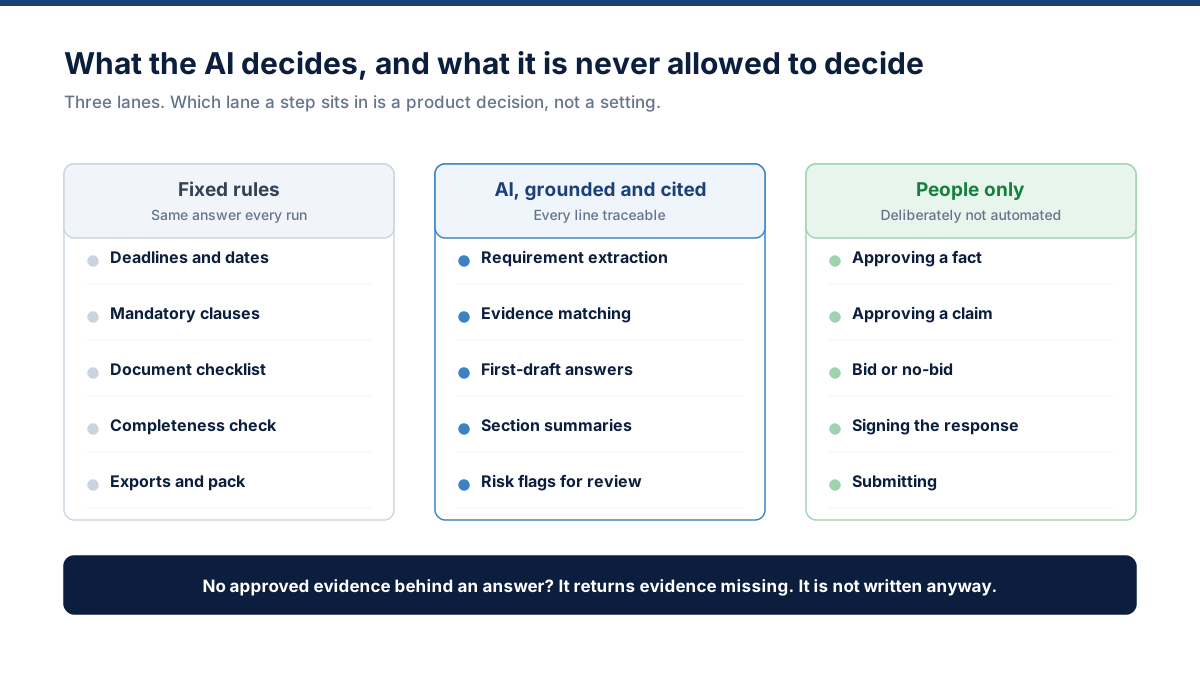
Most of what makes a tender response survive a compliance check is bookkeeping: which requirement is answered, which document is attached, which certificate is still valid on submission day, which addendum changed the specification after you started drafting. None of that benefits from a language model, and all of it benefits from being a tracked field with a state.
So AI tender management here means the register is deterministic and the writing is grounded. The compliance matrix is a real matrix, exported as a spreadsheet the buyer can read. The deadline is a date. The missing certificate is flagged as missing. The AI is used where language is genuinely the work — turning approved evidence into an answer that reads like your company wrote it — and nowhere that a rule would be more reliable.
This matters for public sector and government tendering in particular, where the pass/fail checks are explicit and mechanical, and a response is more often lost on an administrative omission than on the quality of the technical argument.
The longer argument, including what AI must not be allowed to do here · How we check what we publish
Start without an account
The free tender analyzer runs in your browser. Drop a tender document in and it returns the requirements, dates and mandatory clauses it finds. Nothing is uploaded and nothing is stored.
AI tender software, answered plainly
What is AI tender software?
AI tender software reads a tender or RFP pack, extracts the requirements, deadlines and mandatory clauses as structured data, matches each requirement against evidence your organisation has already approved, and drafts responses grounded in that evidence. It is used by the supplier side — the team preparing a bid — rather than by the buyer publishing the tender.
Is this for buyers publishing tenders or suppliers responding to them?
Suppliers responding. TenderOS has no buyer-side features: it does not publish notices, run an evaluation panel, score competing bids or manage a supplier list. If you are the contracting authority issuing the tender, an e-procurement platform is the category you want, not this one.
Does AI write the whole tender response?
No, and a tool that claims it does is describing a liability. The AI produces a first draft of each answer from approved evidence, with citations. Approving a fact, approving a claim, deciding whether to bid at all, signing and submitting are deliberately left to people. Those four are not settings that can be switched to automatic.
How is this different from using ChatGPT on a tender?
A general chat model answers from whatever is in its context plus what it has learned, so it will produce a fluent sentence claiming an ISO certification you do not hold. Tender software retrieves from a knowledge base of facts a named person in your company has confirmed, and refuses to answer when nothing supports the claim. The difference is not writing quality — it is whether the output is checkable before it reaches a buyer.
Does it work for public sector and government tenders?
Yes. Public procurement is where the structure pays off most, because the packs are long, the mandatory requirements are explicit and the pass/fail checks are mechanical. The same extraction and compliance workflow applies to ITTs, RFPs, RFQs, RFIs and pre-qualification questionnaires.
What does it cost?
The browser-based tender analyzer is free and needs no account. Paid plans start at $299 a month for Starter, $799 for Business and $1,499 for Pro, with every included limit listed on the pricing page.