About TenderOS
TenderOS is an AI operating system for tenders, RFPs, bids and proposal responses. It takes the documents a buyer sends, turns them into a structured picture of what is actually being demanded, checks that picture against what your organisation can prove, and helps your team write and validate the response.
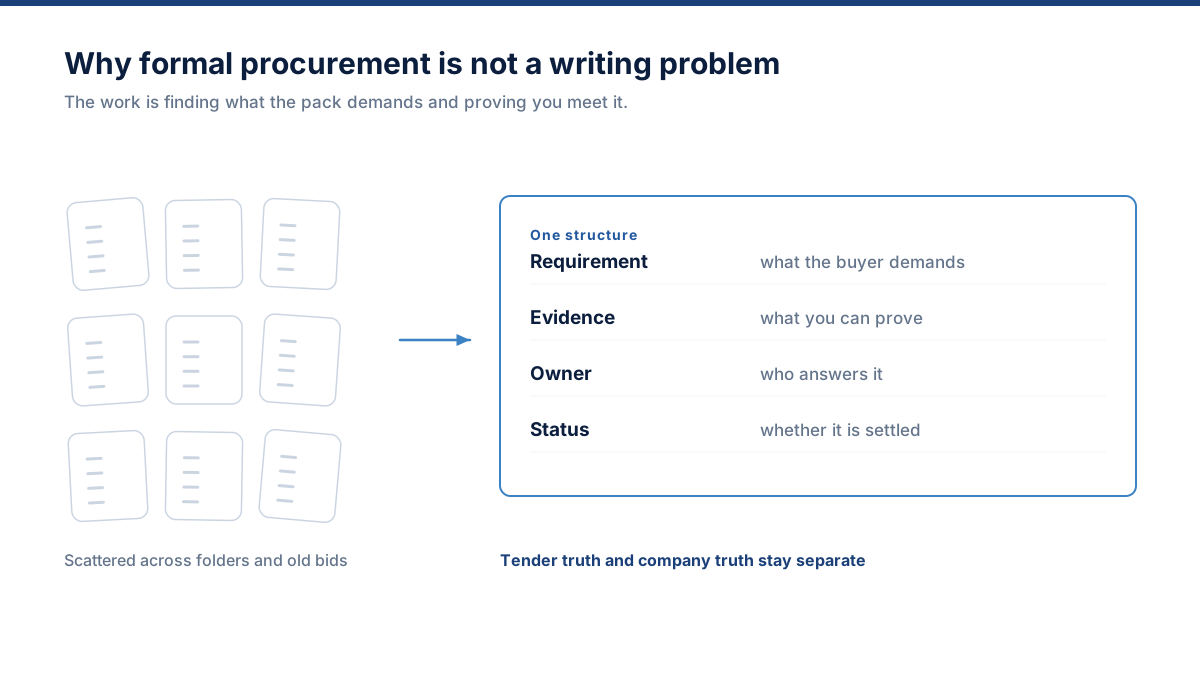
The distinction that shapes everything else. Other AI tools help you write an answer. TenderOS helps you run the entire bid.
Why it exists
Responding to formal procurement — the kind published on Find a Tender, TED or SAM.gov — is not primarily a writing problem. Any competent subject expert can answer a single question well. What breaks teams is that one tender contains well over a hundred obligations scattered across a scope of work, a terms document, three specification annexes and a pricing template; that the evidence proving those obligations lives in four folders, two of them owned by people who have left; that five contributors are answering different sections without a shared picture; and that an addendum can arrive in week four and quietly invalidate work already signed off.
Tools that generate an answer at a time do nothing about any of that. They start at the point where the hard part is already finished, and they are dangerous precisely because they are fluent: a model with no knowledge of your certifications will still produce a confident paragraph claiming them.
What we build
A workspace per tender. The documents are classified and read. Every clause carrying an obligation becomes a tracked requirement with its page and clause reference intact. The mandatory ones are separated by explicit rules rather than by a model's judgement, because a missed pass/fail clause is a disqualification. Each requirement is checked against your Company Brain — certificates, insurances, case studies, CVs, policies and previously approved answers — and where the proof does not exist, the gap is named early enough to close it. Drafting happens last, grounded in that approved material, with missing facts marked rather than invented.
The free tender analyzer is the first stage of that pipeline, cut down to run entirely in your browser. It exists because the fastest way to explain the product is to point it at a document you already have open.
The principles the product is held to
Evidence before eloquence
A well-written claim your company cannot prove is worse than a plain one it can. Every factual company statement in a generated response traces to a document or an explicit human input.
Tender truth and company truth stay separate
What the buyer requires and what your organisation can demonstrate are two distinct bodies of fact. The software may connect them. It may never invent either one.
Automate the work, keep the decision
Reading, structuring, matching and checking are software problems. Whether to bid, what to claim, how to price and when to submit are not.
No number without a basis
No win probability, no accuracy percentage, no time-saving statistic. If it cannot be reconstructed from something real, it is not published.
Say what is missing
When the evidence does not exist, the correct output is a question, not a plausible sentence. Silence and confident invention are the two failure modes that lose contracts.
Self-service by design
Finding the product, analysing a tender, subscribing, onboarding and exporting should all be possible without talking to a person. Human help is an option, not a dependency.
What we refuse to claim
This site carries no customer logos, no testimonials and no case studies, because we have no verified ones to publish yet. It carries no certification badges, because none has been achieved. It carries no percentage of time saved and no win-rate uplift, because there is no measured customer data behind such a figure and inventing one would contradict the entire premise of the product.
When real customers produce real, measurable results, those will appear here as case studies with the method stated. Until then the argument has to stand on what the software does, which you can test on a live tender in about two minutes without giving us anything.
Our editorial policy sets out how the guides on this site are researched and reviewed, and the security page covers how documents are handled.
The fastest way to understand it
Point it at a tender you already have open.