TenderOS Editorial Policy
Last updated: 24 August 2026
TenderOS publishes guides about a field where bad information has real cost: a reader who acts on a wrong statement about mandatory requirements can lose a contract. This page sets out how the material on this site is produced and what we will not print.
Who writes this
Guides are published under the TenderOS team byline. We do not invent named individual authors with fabricated credentials in order to look more authoritative, which is a common practice in this category and an easy one to spot once you look for it.
Statistics we will not publish
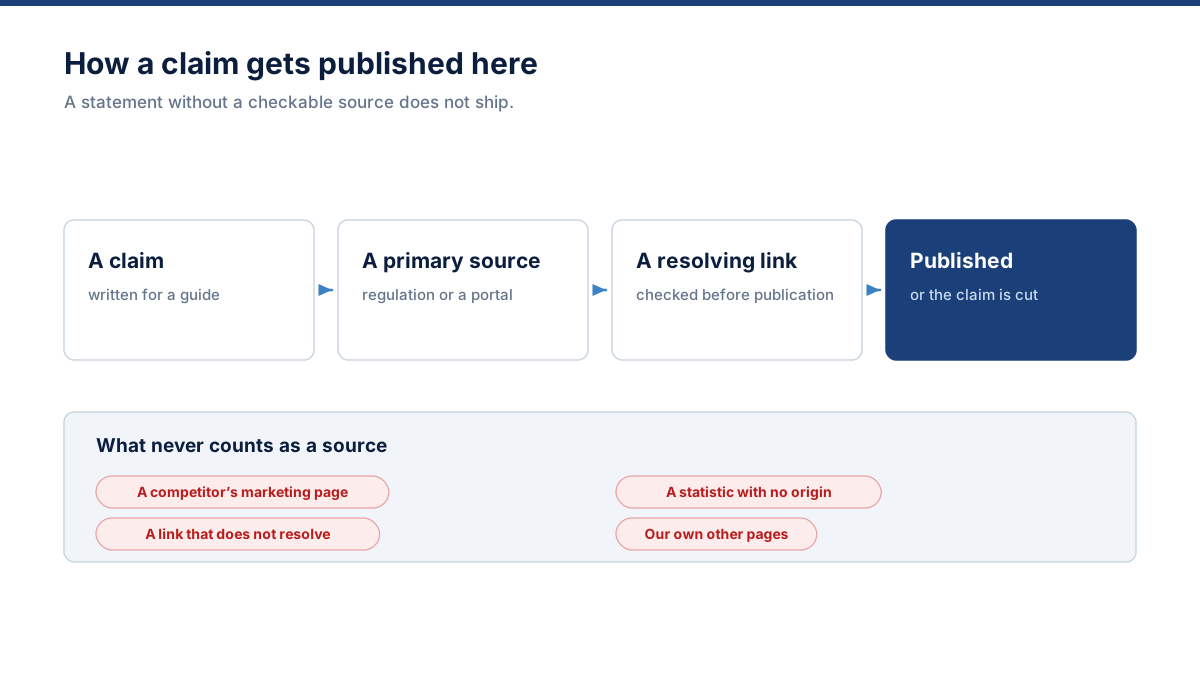
You will not find a percentage of time saved, a win-rate uplift, an "average RFP contains N requirements" figure, an industry adoption number or a market-size claim anywhere on this site — unless it is attributed to a named public source you can open and check.
The reason is straightforward. Numbers of that kind circulate widely in this industry without a traceable origin: one vendor publishes an estimate, three blogs cite the vendor, and within a year it is quoted as established fact. Repeating them would contradict the principle the product itself is built on.
When we have verified customer measurements, they will appear as case studies naming the organisation, the measurement method and the period.
External sources
Every external link in a guide points to a primary source and is checked to resolve before publication. In practice that means four kinds of place: procurement regulation such as the Procurement Act 2023, the government tender services themselves — Find a Tender, TED, SAM.gov — standards bodies such as ISO, and professional associations such as the APMP. We do not cite competitor marketing pages as evidence for factual claims.
How AI is used in our own content
Drafting is AI-assisted, and it would be odd for a company selling AI-assisted drafting to pretend otherwise. What matters is the constraint around it. Drafts are produced against a brief that fixes the source URL in advance rather than letting a model choose one, because models invent plausible-looking URLs that do not exist. Every draft is then checked automatically for fabricated statistics, unverifiable performance claims, invented external links, guarantee language and structural defects, and reviewed before it is published.
The same rule we apply to the product applies here: a claim that cannot be traced to a source does not ship.
Competitor and comparison content
We do not publish feature-by-feature or price-by-price comparisons against named competitor products. Their features and pricing change frequently, published details go stale within months, and a comparison written by one of the vendors is not a neutral document however carefully it is worded.
What we publish instead is evaluation frameworks: the questions worth asking any vendor, the tests worth running during a trial, and the migration risks worth checking before switching. See how to evaluate RFP software and the switching checklist.
Commercial relationships
Every guide on this site is published by the company that makes TenderOS, and every one recommends TenderOS. That is stated openly rather than buried. There are no affiliate links, no paid placements and no sponsored reviews on this site, and no third party pays to appear in or influence any guide.
Templates and examples
Templates, checklists, matrix column structures and example clauses published here are written for illustration. Where a sample tender is used — including the demo document in the free analyzer — the organisation, project, dates and thresholds are fictional and labelled as such. We do not reproduce real confidential procurement documents.
Corrections and updates
Guides are reviewed on a rolling basis and carry a published date, with an updated date once revised. If you find an error, write to [email protected] and it will be corrected rather than quietly edited away.
Product claims
Descriptions of what TenderOS does describe what it does. Planned capabilities are labelled as planned. The security page lists implemented controls only and states plainly which certifications have not been obtained, and the pricing page publishes every included limit rather than hiding volumes behind a sales conversation.